Solid Wood vs Particle Board: What Can Be Restored?
The substrate underneath the finish dictates what can be safely restored. Solid hardwood allows full stripping and re-staining, fine vintage veneer requires gentle precision to avoid sand-through, and swollen particle board is rarely worth the investment.
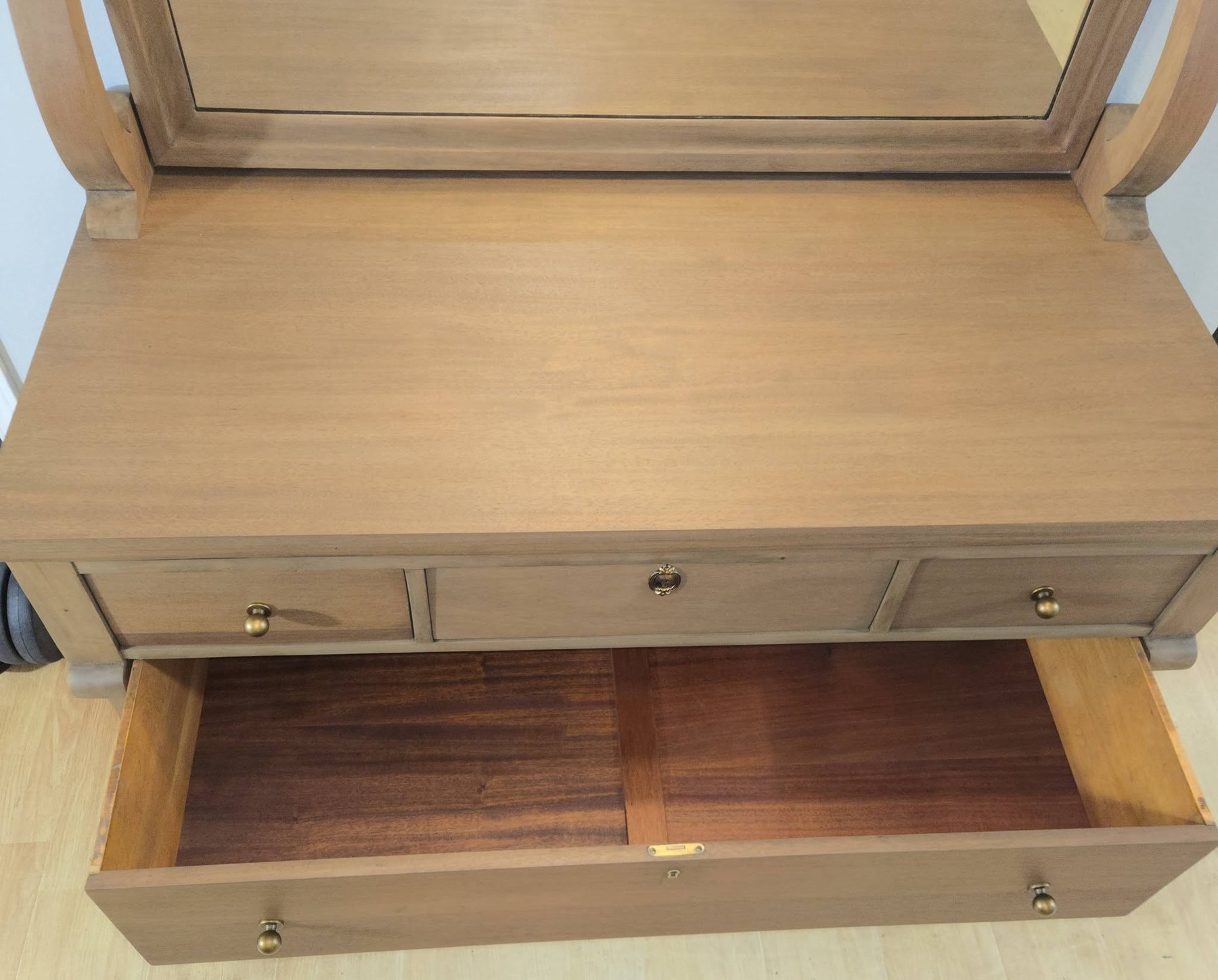
Compare the core before you choose a finish.
Natural continuous timber throughout (oak, walnut, maple, cherry). Growth rings run through ends and edges.
- 100% sandable & stainable
- Durable dovetailed joinery
- Repairs hold long-term value
Genuine hardwood sheet bonded over solid core. High-end feature of 1920s–1950s Sligh and Grand Rapids case pieces.
- Stripping requires hand solvent prep
- Risk of edge sand-through if rushed
- Excellent candidate for paint or toning
Compressed sawdust, glue, and printed paper/plastic veneer. Cannot be sanded or re-stained once damaged.
- Moisture causes irreversible swelling
- Screw holes crumble and strip easily
- Rarely cost-effective to restore
3 Quick Tests to Identify Real Wood at Home
You can quickly diagnose your piece before sending photos by checking these three specific areas:
- Check the End Grain: On solid wood, grain lines wrap continuously over the top edge and continue down the sides. On laminate or particle board, edges have a distinct plastic or tape seam where the banding meets the face.
- Inspect Drawer Construction: Pull a drawer all the way out. Dovetail joinery connecting solid wooden drawer sides to the face indicates genuine heirloom construction. Stapled particle board or vinyl-wrapped drawer boxes signify mass-produced flatpack.
- The Weight & Underside Test: Look at the unfinished underside of a table or dresser bottom. Solid wood will show raw timber with natural sawmill markings and knots. Particle board appears as a speckled, pressed composite or rough brown masonite.
Can Veneer Furniture Be Refinished?
Yes — but it requires experience and controlled hand work. Vintage furniture from respected makers like Sligh, Kent-Coffey, and Drexel frequently utilized premium quarter-sawn walnut or mahogany veneers over solid lumber cores to create balanced grain patterns impossible in solid timber slabs.
Because the top decorative veneer layer is typically only 1/16" to 1/32" thick, aggressive mechanical belt sanding will burn straight through to the core substrate, permanently ruining the piece. In our studio, we use gentle solvent hand-stripping, light blocking with fine grits, and cosmetic chip repair with color-matched epoxy putty before applying fresh stains or durable satin enamels.
What About Particle Board or Laminate?
While cosmetic touch-ups can temporarily hide scratches on particle board furniture, we generally advise against paying for professional restoration on compressed wood pieces. When moisture penetrates a seam in particle board, the wood fibers expand like a sponge and permanently swell — sanding cannot flatten the blown core, and replacement costs for new flatpack furniture are often lower than studio restoration labor.