How to tell if furniture is real wood.
First, clear up the biggest myth: "Veneer" is not the opposite of real wood. Traditional wood veneer is real hardwood sliced thin and bonded over a core substrate—which may be solid lumber, multi-ply hardwood plywood, or modern particleboard/MDF. Because surface appearance or weight alone can be misleading, you need to check several construction clues together before deciding how a piece can be restored.
Combine four clues—never rely on just one.
Solid lumber shows porous end grain on perpendicular ends; veneered or laminated panels show a thin horizontal seam or edge banding.
Hidden undersides and inside cabinet frames rarely get decorative veneer—revealing whether the core is lumber, plywood, or particleboard.
Interlocking wood dovetails point to quality cabinetmaking, though solid-wood drawer boxes are often paired with veneered exterior panels.
1. Solid wood, real wood veneer, plywood, and composites explained
Before inspecting a piece, it helps to separate four materials that frequently get lumped together in furniture listings (for how each material behaves during stripping and sanding, see our solid wood vs. particle board restoration guide):
- Solid lumber (hardwood or softwood): Boards milled directly from the tree—such as oak, walnut, cherry, maple, mahogany, birch, or pine—glued edge-to-edge into wide panels.
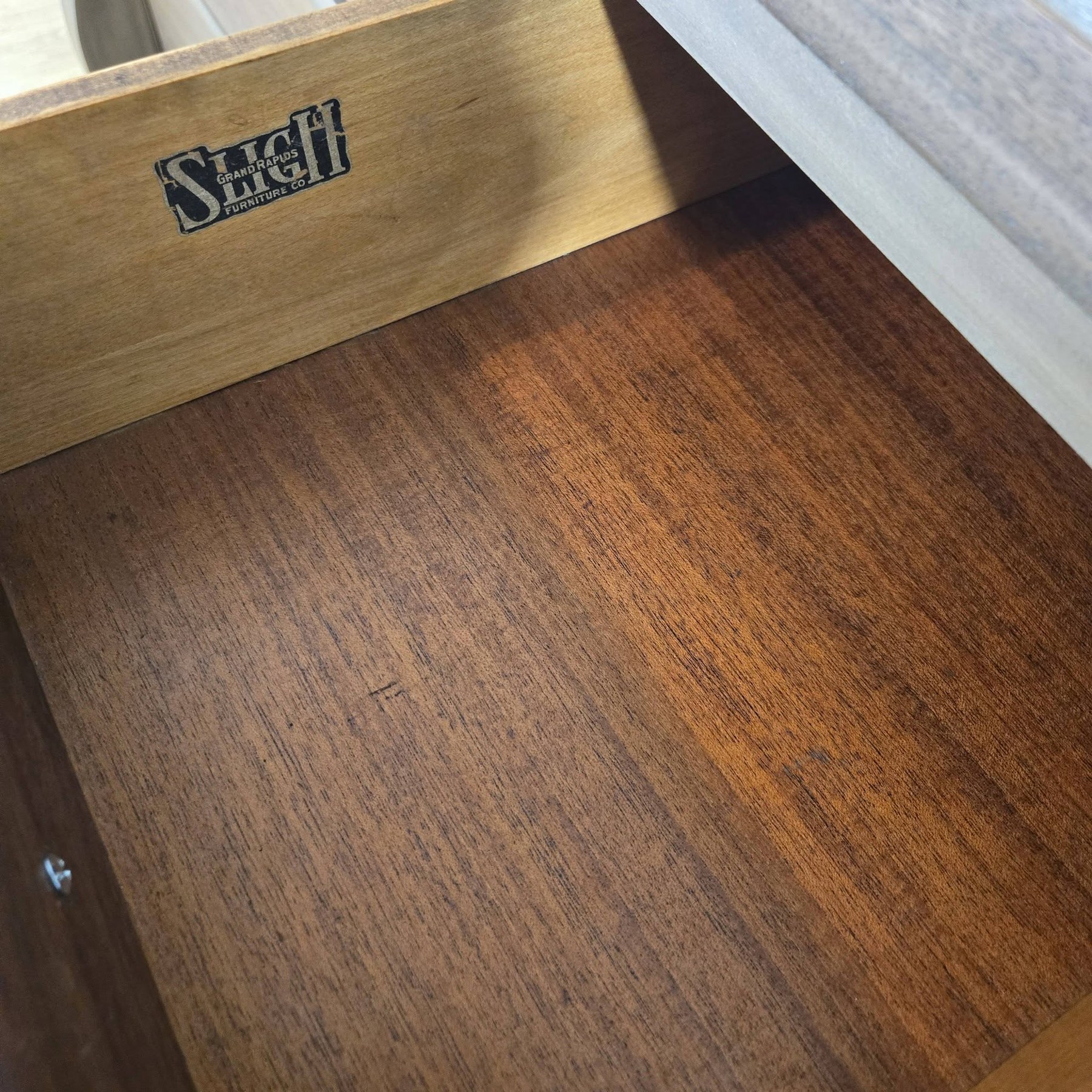
- Real wood veneer over lumber-core or hardwood plywood: A thin slice of genuine hardwood bonded to a stable wooden core. For centuries, fine furniture makers—including the makers of our Grand Rapids mahogany sleigh dresser—used hardwood veneer over solid poplar or multi-ply cores so wide tops and curved drawer fronts would not warp, split, or seasonal-crack, and so dramatic "bookmatched" grain patterns could be mirrored across doors.
- Real wood veneer over particleboard or MDF: Common in mid-to-late 20th-century and contemporary retail furniture. The outer surface is still real wood that can accept light hand-sanding or paint, but the compressed wood-fiber core underneath is heavy and vulnerable to moisture swelling at the edges.
- Paper, foil, or vinyl laminate over composite board: A photographic print or plastic film glued over particleboard or medium-density fiberboard (MDF). There is no real wood grain on the surface.
2. Four practical places to inspect on any piece
Because a single surface clue can fool even experienced buyers, examine these four areas together:
- Look at the perpendicular end of the tabletop: On a solid-wood tabletop, the long grain lines running across the top flow over the front and back edges, while the left and right ends reveal end grain—short, porous growth rings where the board was crosscut. If all four edges show long horizontal grain meeting at a crisp 90° line (or if you see a faint glue line 1/32" below the top surface), the top is veneered or edge-banded.
- Inspect the unfinished underside and inside of the case: Pull a bottom drawer completely out and look up inside the cabinet frame with a phone flashlight. Solid planks show natural board widths, knots, or planer marks; architectural plywood shows thin stacked wood plies at cut edges; particleboard looks speckled like pressed sawdust; and MDF looks like dense, uniform tan cardboard.
- Check grain symmetry and pattern repetition: Nature never grows two identical boards. If two adjacent cabinet doors or the left and right halves of a dresser drawer mirror each other like a butterfly's wings, you are looking at bookmatched real wood veneer—a hallmark of quality cabinetmaking. Conversely, if two separate drawers have the exact same knot and swirl printed in the same spot, the surface is a synthetic photographic laminate.
- Examine drawer sides and interior stamps: Pull out the top drawer and look at the side joint. Interlocking trapezoidal pins and tails (dovetails) cut into solid oak, maple, or sycamore drawer sides indicate traditional construction. Also check inside the drawer or on the back panel for burned-in maker marks or paper factory labels.
3. Why a single clue is never conclusive (realistic limitations)
Avoid categorical rules that promise you can identify furniture from a single test. Nearly every popular shortcut has exceptions:
- The weight trap: "Heavy means solid wood" is one of the most common misconceptions. High-density particleboard and MDF are bound with heavy urea-formaldehyde resins and often weigh more than solid pine, poplar, or cedar.
- Mixed construction is the norm, not the exception: Most vintage dressers, buffets, and desks combine materials intentionally—using solid turned hardwood legs and solid dovetailed drawer boxes alongside veneered plywood side panels and tops. Finding dovetails inside a drawer proves the drawer box is well built, but you still need to check whether the tabletop is solid lumber or thin veneer before sanding it aggressively.
- Opaque paint or dark factory toner hides grain transitions: When a piece has been painted or sprayed with heavy dark lacquer toner, end-grain pores and veneer seams may be completely concealed until an inconspicuous underside edge is inspected.
- Shaped or molded edges can disguise cores: Manufacturers often glue solid-wood molding strips around the perimeter of a veneered plywood or MDF tabletop so the router can cut a decorative bevel without exposing the core.